
TinyTask for Mac: Best Alternatives and How to Automate on macOS
TinyTask is a 36 KB macro recorder that millions of Windows users rely on to automate repetitive mouse clicks and keyboard inputs. But if you have searched for “TinyTask for Mac,” you already know the problem: TinyTask does not run on macOS. It was built using Windows-specific APIs (SetCursorPos and SendInput) that simply do not exist on Apple’s operating system.
This guide covers every option available to Mac users who want TinyTask-style automation. We compare seven alternatives – from free built-in tools to professional macro engines – explain whether running TinyTask through emulation actually works, and walk you through setting up your first macro on macOS step by step.
Quick answer: The closest free replacement for TinyTask on Mac is Automator (pre-installed on every Mac). The best overall replacement is Keyboard Maestro ($36 one-time). If you need something that records and replays mouse movements exactly like TinyTask, PyMacroRecord (free, open-source) is the closest match.
Does TinyTask Work on Mac?
No. TinyTask is a Windows-only portable executable. There is no official macOS version, no planned Mac port, and the developer has not released updates in years. The program relies on Win32 API functions to capture and replay mouse/keyboard events – functions that have no equivalent in macOS.
You cannot simply download TinyTask.exe and run it on a Mac. macOS does not execute Windows .exe files natively. Some users try workarounds through emulation or virtual machines, but the results are disappointing for macro recording specifically.
Can You Run TinyTask on Mac Through Wine or Emulation?
Technically, TinyTask can launch inside a Wine-based emulation layer on Mac. Tools like Whisky (free, open-source Wine frontend for Apple Silicon) or CrossOver ($74/year) can run the TinyTask executable. The program opens, the toolbar appears, and you can even record a macro.
The fatal problem: TinyTask running inside Wine cannot interact with native macOS applications. It can only control other apps running inside the same Wine environment. Since the entire point of TinyTask is automating YOUR apps – browsers, games, productivity tools – this makes Wine-based TinyTask essentially useless for real work.
A confirmed test from r/macgaming on an M2 MacBook Pro: “It seems to be working fine on itself and other executable files launched through Whisky but it can not interact with apps open.” This is a fundamental limitation of how Wine translates Windows API calls – the simulated mouse events never reach native macOS windows.
Do not waste time with Wine/CrossOver for TinyTask. The program technically runs but cannot control macOS apps. Use a native Mac alternative instead.
What About Parallels or VMware?
Running a full Windows virtual machine through Parallels Desktop ($99.99 one-time or $79.99/year) or VMware Fusion does work – TinyTask runs perfectly inside Windows VM. But it only automates apps inside that VM. If you need to automate a macOS-native app (Safari, Finder, Pages, or any Mac software), TinyTask in a VM cannot reach it.
Parallels makes sense only if you already run Windows apps on your Mac and want to automate those specific Windows applications. For automating anything native to macOS, you need a Mac-native tool.
Boot Camp?
Boot Camp allowed Intel Macs to dual-boot Windows, where TinyTask runs perfectly. However, Apple removed Boot Camp entirely from Apple Silicon Macs (M1, M2, M3, M4). Since every Mac sold since late 2020 uses Apple Silicon, Boot Camp is no longer an option for the vast majority of Mac users.
Best TinyTask Alternatives for Mac
Here are seven Mac-native tools that replace TinyTask’s functionality, ranked by how closely they match TinyTask’s record-and-replay simplicity. Each tool is tested and verified on macOS Sonoma and Sequoia with Apple Silicon support.
Keyboard Maestro 11
Keyboard Maestro is the tool most Mac power users recommend when asked for a TinyTask replacement. It can record mouse clicks and keystrokes like TinyTask, but it goes much further: 100+ trigger types (hotkeys, app launch, USB connection, time-based, clipboard changes), 300+ built-in actions, OCR screen reading, image recognition, and full scripting support via AppleScript, JavaScript, or shell scripts.
Where TinyTask records raw pixel coordinates that break when you move a window, Keyboard Maestro can target UI elements by name – making macros dramatically more reliable. Version 11 (released May 2025) added a Macro Wizard for guided creation, improved dark mode support, and better macOS Sequoia compatibility.
The $36 price tag covers one user on up to 5 Macs. It is a one-time purchase, not a subscription. Upgrades from older versions cost $25.
- Records mouse and keyboard like TinyTask
- 300+ actions with visual editor
- OCR and image recognition
- Targets UI elements by name (not just coordinates)
- Active development with regular updates
- Huge community with shared macros
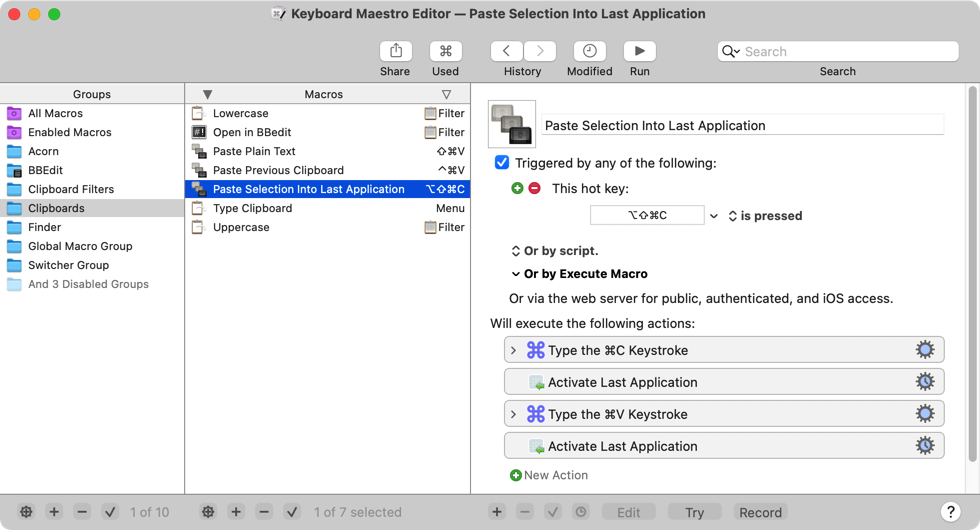
Keyboard Maestro 11’s macro editor – groups on the left, macros in the center, actions and triggers on the right
Automator
Automator is Apple’s built-in automation tool, pre-installed on every Mac. Its “Watch Me Do” feature works almost exactly like TinyTask – it records your mouse movements, clicks, and keystrokes, then replays them. You do not need to download or install anything.
The catch: Automator’s “Watch Me Do” recording is unreliable on modern macOS. It frequently fails to replay correctly when dealing with dynamic UIs, animations, or apps that change layout between sessions. For simple, predictable sequences (clicking the same button in the same spot every time), it works. For anything more complex, it frustrates more than it helps.
Apple has been gradually shifting focus to the Shortcuts app, so Automator feels increasingly dated. But as a free, zero-install option for basic macro recording, it is hard to beat.
- Free and pre-installed on every Mac
- “Watch Me Do” records mouse like TinyTask
- 200+ drag-and-drop actions
- Integrates with AppleScript and shell scripts
- “Watch Me Do” is unreliable in complex UIs
- No longer actively developed by Apple
PyMacroRecord
If you want the closest functional equivalent to TinyTask on Mac, PyMacroRecord is it. It records mouse movements, clicks, scrolls, and keystrokes, saves them to a JSON file, and replays them with adjustable speed and infinite looping. The workflow is nearly identical to TinyTask: press record, do your actions, press stop, press play.
The only friction is setup. You need Python 3 installed (most Macs have it, or install via Homebrew with brew install python) and you install PyMacroRecord via pip. Once installed, it works as a simple GUI application.
Because it saves macros as human-readable JSON files, you can manually edit timings, add delays, or remove unwanted steps – something TinyTask’s binary .rec format does not allow.
- Records and replays mouse + keyboard (like TinyTask)
- Infinite loop and speed adjustment
- JSON format – editable and shareable
- Cross-platform (works on Mac, Windows, Linux)
- Requires Python 3 and pip installation
- No visual macro editor

PyMacroRecord’s interface – record, playback, and settings controls similar to TinyTask
BetterTouchTool
BetterTouchTool is primarily an input customization tool – it lets you create custom trackpad gestures, Magic Mouse actions, keyboard shortcuts, and Touch Bar buttons. It also includes a capable macro engine that can simulate mouse clicks, keystrokes, and multi-step sequences triggered by gestures or hotkeys.
BTT does not record mouse movements in the “press record and replay” style of TinyTask. Instead, you build action sequences manually in a visual editor. This makes it less intuitive for simple record-and-replay tasks but more robust for gesture-triggered automation. If you want a three-finger swipe to trigger a specific sequence of actions, BTT is the best tool for that job.
The Standard License costs around $12 (2 years of updates) and the Lifetime License is around $25. A 45-day free trial is available.
- Deep trackpad and gesture customization
- Window snapping and tiling
- AppleScript and shell script support
- Custom floating menus and context menus
- No record-and-replay mouse recording
- macOS Sequoia permission pop-up issues
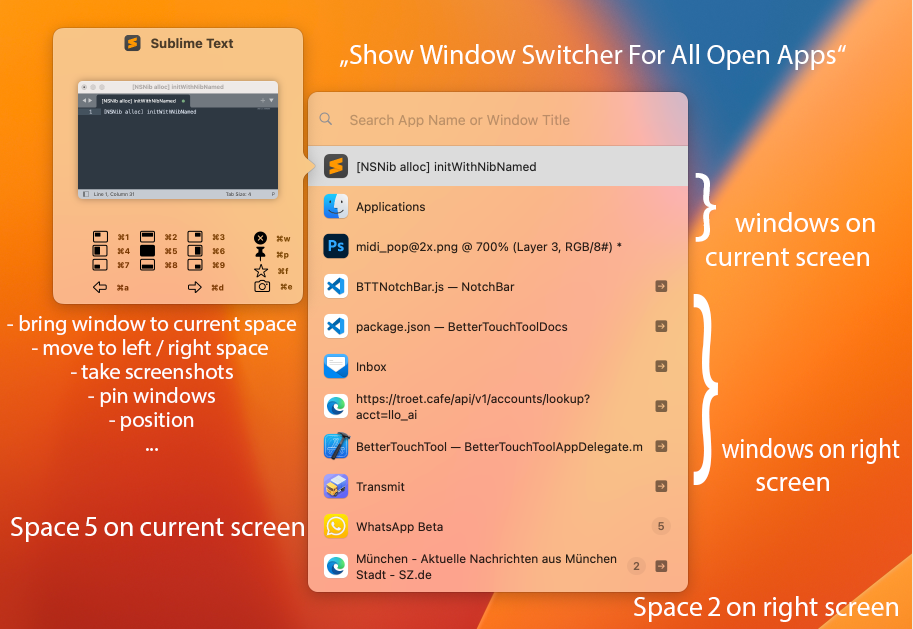
BetterTouchTool’s window switcher – one of many automation features beyond basic macro recording
Hammerspoon
Hammerspoon is a scripting engine that gives you programmatic access to nearly every macOS system API through Lua. It can simulate mouse clicks, keyboard inputs, manage windows, monitor USB devices, handle WiFi events, draw screen overlays, and make HTTP requests. If you can describe what you want your Mac to do, Hammerspoon can probably do it.
The tradeoff is that Hammerspoon has no record button. You write Lua config files that describe your automation. This makes it the most powerful option on this list but also the least accessible for users who just want to click Record and Play. Version 1.1.1 (February 2026) marked its first stable 1.x release after a decade of development.
- Access to nearly every macOS API
- Extremely low resource usage
- Massive community with shared configs (“Spoons”)
- Free, open-source, actively maintained
- Requires writing Lua scripts (no GUI recorder)
- Steep learning curve for non-programmers
MurGaa Macro Recorder
MurGaa Macro Recorder is the closest thing to TinyTask’s spirit on Mac – a simple, focused tool that records mouse movements, clicks, and keystrokes, then replays them with configurable repeat counts and speed. The interface is minimal and single-purpose, designed for users who want to record and replay without learning a complex system.
The downside is the pricing model. Instead of a one-time purchase, MurGaa charges $7.89 for a 6-month license per Mac. That adds up over time compared to Keyboard Maestro’s one-time $36. A free trial is available with limited replay count so you can test before buying.
- Simple record-and-replay (like TinyTask)
- Minimal, focused interface
- Mouse + keyboard recording
- Configurable repeat and speed
- Recurring 6-month license fee
- Smaller community and fewer resources
Jitbit Macro Recorder
Jitbit Macro Recorder bridges the gap between TinyTask’s simplicity and Keyboard Maestro’s power. It records mouse movements, clicks, scrolls, and keystrokes with a visual timeline editor where you can tweak delays, insert conditions, and modify recorded actions after the fact. It also includes OCR-based screen reading for more advanced automation.
The personal license costs $20-$40 one-time depending on the edition. A free demo is available with usage limitations. Jitbit works on both Mac and Windows, so if you switch between platforms, your macros transfer.
- Visual macro editor with timeline
- Records mouse + keyboard like TinyTask
- OCR screen reading
- Cross-platform (Mac + Windows)
- Paid (no free tier beyond demo)
- Less community support than Keyboard Maestro
Full Comparison Table
| Tool | Price | Mouse Recording | Loop / Repeat | Ease of Use | Best For |
|---|---|---|---|---|---|
| TinyTask | Free | Yes (Windows only) | Yes | Beginner | Windows users – does not work on Mac |
| Keyboard Maestro | $36 one-time | Yes (robust) | Full control | Intermediate | Power users who want reliable automation |
| Automator | Free (built-in) | Yes (unreliable) | Yes | Beginner | Simple tasks without installing anything |
| PyMacroRecord | Free (open source) | Yes | Yes (infinite) | Moderate | Users who want the closest TinyTask clone |
| BetterTouchTool | $12-$25 one-time | No (manual actions) | Yes | Intermediate | Gesture and trackpad automation |
| Hammerspoon | Free (open source) | Scripted only | Yes (code) | Advanced | Developers who want full system API access |
| MurGaa Recorder | $7.89 / 6 months | Yes | Yes | Beginner | Simple record-replay on Mac |
| Jitbit Recorder | $20-$40 one-time | Yes | Yes | Beginner-Intermediate | Visual editing with cross-platform support |
How to Set Up Your First Macro on Mac
If you want the fastest path from zero to a working macro on Mac, here are step-by-step instructions for the two most common choices: Automator (free, already on your Mac) and Keyboard Maestro (paid, most powerful).
Option A: Using Automator (Free)
1 Open Automator
Press Cmd + Space to open Spotlight, type Automator, and press Enter. When the document picker appears, select “Workflow” as the type and click Choose.
2 Start Recording
In the Automator toolbar, click the Record button (red circle icon). Automator will minimize and begin capturing everything you do – mouse movements, clicks, and keystrokes. A small floating bar stays visible with Stop and Pause buttons.
3 Perform Your Actions
Do the actions you want to automate. Click buttons, type text, switch between windows. Move at a deliberate pace – Automator records timing exactly as you perform it. When finished, click Stop on the floating recording bar.
4 Play Back
You will see a “Watch Me Do” action block in the Automator workflow. Click the Run button (green play icon) in the top-right to replay your recorded actions. Automator will repeat exactly what you did, at the same speed.
5 Save for Later
Go to File → Save and save as a Workflow file (.workflow). To make it even easier to run, go to File → Export and save as an Application – this creates a double-clickable app that runs your macro.
Automator will ask for Accessibility permissions the first time you try to record or replay actions that control other apps. Go to System Settings → Privacy & Security → Accessibility and enable Automator. You may need to restart the app after granting permission.
Option B: Using Keyboard Maestro ($36)
1 Install Keyboard Maestro
Download from keyboardmaestro.com (37 MB). Open the DMG and drag Keyboard Maestro to Applications. Launch it – the app will ask for Accessibility and Screen Recording permissions. Grant both in System Settings → Privacy & Security.
2 Create a New Macro
In the Keyboard Maestro Editor, click the + button at the bottom to create a new macro. Give it a name like “My First Macro.” Set a trigger – for example, a hotkey like Ctrl + Option + R – by clicking the trigger area and pressing your chosen keys.
3 Record Actions
Click the Record button at the bottom-right of the editor window. Keyboard Maestro will minimize and start recording your mouse clicks and keystrokes. Perform your actions, then press the hotkey you set to stop recording. Your actions appear as editable steps in the macro editor.
4 Edit and Refine
Unlike TinyTask, Keyboard Maestro lets you edit individual steps after recording. You can adjust delays, change click coordinates, add conditions (“only run if Safari is the frontmost app”), and insert additional actions from the 300+ action library. This is where Keyboard Maestro’s power shows.
5 Run Your Macro
Press your assigned hotkey to run the macro anytime. For looping, add a Repeat action wrapping your recorded steps and set it to repeat a specific number of times or until a condition is met. Keyboard Maestro runs silently in the background – it does not need a visible window.
macOS Permission Requirements
Every macro tool on macOS needs specific system permissions to function. This is a security feature Apple introduced to prevent malicious software from controlling your computer without your knowledge. If you skip these permissions, your macro tool will silently fail to record or replay.
Accessibility Permission (Required by ALL tools)
This permission allows an app to simulate mouse clicks and keyboard presses in other applications. Without it, no macro tool can control anything beyond its own window.
How to grant: System Settings → Privacy & Security → Accessibility → Click the + button → Select the app → Toggle it on. You may need to unlock the settings with your admin password first.
Screen Recording Permission (Required by some tools)
Tools that need to “see” your screen (for OCR, image matching, or visual triggers) require Screen Recording permission. Keyboard Maestro and BetterTouchTool both need this.
macOS Sequoia issue: macOS 15 Sequoia introduced more aggressive permission prompts that re-appear weekly for some users. If this happens, run tccutil reset ScreenCapture in Terminal, then re-grant the permission. Keyboard Maestro 11.0.3+ addresses the worst cases.
Gatekeeper for Unsigned Apps
Some free tools (Hammerspoon, PyMacroRecord) may trigger Gatekeeper warnings because they are not notarized by Apple. On macOS Sequoia, the old “right-click → Open” bypass no longer works. Instead: attempt to open the app (it gets blocked), go to System Settings → Privacy & Security, scroll down to find the blocked app, and click “Open Anyway.” Or run xattr -cr /path/to/App.app in Terminal.
Frequently Asked Questions
Is there a TinyTask for Mac?
No, there is no official TinyTask for Mac. TinyTask is a Windows-only application built using Win32 APIs (SetCursorPos and SendInput) that do not exist on macOS. The developer has never released a Mac version and has not updated the software in years, so a Mac port is extremely unlikely.
Running TinyTask through Wine or CrossOver on Mac is technically possible, but the program cannot interact with native macOS applications – it can only control other apps running inside the same Wine environment, making it useless for real automation work.
The closest free alternatives that actually work on Mac are:
- Automator – Built into macOS, has a “Watch Me Do” recording feature similar to TinyTask
- PyMacroRecord – Free, open-source, records and replays mouse/keyboard input identically to TinyTask
- Keyboard Maestro ($36) – The most powerful option with recording, editing, and 300+ actions
Pro tip: If you only need basic click automation (not full mouse recording), the free Automator “Watch Me Do” feature handles most simple use cases without installing anything.
For Windows users, download TinyTask here.
What is the best free macro recorder for Mac?
Automator is the best free macro recorder already on your Mac. It is pre-installed on every macOS version, requires no download, and its “Watch Me Do” feature records mouse movements, clicks, and keystrokes like TinyTask does. Open Spotlight (Cmd + Space), type “Automator,” create a new Workflow, and click the Record button to start capturing.
If Automator’s recording proves unreliable for your use case (it struggles with dynamic UIs), PyMacroRecord is the best free alternative that requires installation. It is open-source, records mouse and keyboard input to editable JSON files, supports infinite looping, and works on Mac, Windows, and Linux. Installation requires Python 3 and pip.
For users comfortable with code, Hammerspoon (free, open-source) provides the most powerful automation engine on Mac. It does not record macros visually – you write Lua scripts instead – but it can access nearly every macOS system API and runs with negligible resource usage.
Pro tip: Start with Automator since it is already on your Mac. If its recording does not work reliably for your specific task, install PyMacroRecord as your next step. Only move to Hammerspoon if you are comfortable writing scripts and need deep system-level control.
Need the Windows version instead? Download TinyTask for free.
Can I run TinyTask on Mac using Wine or Parallels?
TinyTask can technically run inside Wine (via Whisky or CrossOver) and Parallels on Mac, but with a critical limitation: it cannot control native macOS applications. TinyTask running inside Wine can only interact with other apps inside the same Wine environment. TinyTask running inside Parallels can only control apps inside the Windows virtual machine.
This limitation exists because TinyTask sends mouse and keyboard events through Windows API calls (SetCursorPos, SendInput). When running under emulation, these calls only reach the emulated Windows environment – they never bridge to native macOS. A confirmed test from r/macgaming: “It seems to be working fine on itself and other executable files launched through Whisky but it can not interact with apps open.”
The only scenario where TinyTask via Parallels makes sense is if you need to automate Windows-specific applications that you are already running inside a Windows VM. For automating native macOS apps (Safari, Finder, Mail, or any Mac software), you must use a Mac-native tool.
- Wine/Whisky/CrossOver – TinyTask launches but cannot reach macOS apps. Not recommended.
- Parallels/VMware – TinyTask works inside the Windows VM only. Worth it only if you already use Parallels for Windows apps.
- Boot Camp – Works perfectly on Intel Macs (dual-boots into real Windows). Dead on Apple Silicon Macs (M1/M2/M3/M4) since Apple removed Boot Camp.
Pro tip: Do not spend $80-$100 on Parallels just to run TinyTask. Buy Keyboard Maestro for $36 instead – it is more powerful, runs natively on macOS, and does not require maintaining a Windows VM.
Keyboard Maestro vs Automator – which should I use?
Use Automator if you need a free, quick solution for simple one-off tasks. Use Keyboard Maestro if you plan to automate regularly or need macros that work reliably across app updates and system changes.
The core differences:
- Recording reliability: Automator’s “Watch Me Do” recording is notoriously unreliable with modern macOS apps that use animations, dynamic layouts, or web views. Keyboard Maestro can target UI elements by name and accessibility labels, making recordings survive app updates that change button positions.
- Triggers: Automator runs manually (double-click) or through Folder Actions. Keyboard Maestro has 100+ trigger types – hotkeys, typed strings, app activation, USB device connection, time schedules, clipboard changes, and WiFi events.
- Editing: Automator lets you drag and drop action blocks but offers limited post-recording editing. Keyboard Maestro gives you a full visual editor where every step is editable with conditions, branches, and variables.
- Price: Automator is free. Keyboard Maestro is $36 one-time (not a subscription).
A representative comment from r/macapps: “KeyboardMaestro being the most powerful, I would forget about the other two to avoid running into limitations. With it you can do things like: when battery percentage is below a threshold, enable Low Power Mode / when an image file is copied to Desktop, optimize its size / when you press a hotkey in some native app, trigger a macro that fills in text fields.”
Pro tip: Try Automator first since it costs nothing. If you find yourself fighting with unreliable recordings or wishing for more trigger options, Keyboard Maestro’s $36 will save you hours of frustration.
If you use Windows, TinyTask is free and does the job without needing either of these tools.
How do I record mouse clicks on Mac for free?
The fastest way to record mouse clicks on Mac for free is Automator’s “Watch Me Do” feature, which is pre-installed on every Mac. Open Automator from Spotlight (Cmd + Space, type “Automator”), create a new Workflow, and click the Record button in the toolbar. Automator will capture your mouse movements, clicks, and keystrokes, then replay them when you press Run.
Step-by-step process:
- Open Automator and choose “Workflow” as the document type
- Click the Record button (red circle) in the toolbar
- Perform your mouse clicks and keyboard actions at a deliberate pace
- Click Stop on the floating recording bar when finished
- Click Run (green play button) to replay your recording
- Save as a Workflow or export as an Application for future use
If Automator does not work reliably for your specific task (common with dynamic web pages and modern app UIs), install PyMacroRecord. It requires Python 3 (install via brew install python if needed) and pip (pip install pymacrorecord). Once installed, it provides a simple GUI with Record, Stop, and Play buttons – very similar to TinyTask’s workflow.
Pro tip: Before recording in Automator, grant it Accessibility permissions (System Settings → Privacy & Security → Accessibility). Without this permission, Automator can record but cannot replay clicks in other applications – the macro runs but nothing happens.
Check our auto clicker guide for more Mac and Windows click automation options.
Does TinyTask work on M1, M2, M3, or M4 Mac?
No, TinyTask does not work natively on any Mac, regardless of whether it has an Apple Silicon chip (M1, M2, M3, M4) or an older Intel processor. TinyTask is a Windows executable that requires Windows APIs to function. The chip architecture is not the issue – the operating system is.
Apple Silicon Macs have fewer workaround options than Intel Macs:
- Boot Camp is completely unavailable on Apple Silicon. Apple removed dual-boot Windows support when switching from Intel to M1 chips in 2020.
- Parallels Desktop runs Windows ARM in a virtual machine on Apple Silicon. TinyTask works inside the VM but cannot reach native Mac apps.
- Wine via Whisky can translate and run TinyTask but with the same isolation problem – no control over macOS apps.
All seven Mac alternatives listed in this guide run natively on Apple Silicon without Rosetta 2 translation. Keyboard Maestro, BetterTouchTool, and Hammerspoon all ship universal binaries optimized for M-series chips. PyMacroRecord works through Homebrew-installed Python which is also Apple Silicon native.
Pro tip: If you just bought an M-series Mac and are coming from Windows, Keyboard Maestro ($36 one-time) replaces TinyTask and then some. It runs natively on Apple Silicon with excellent performance and can do everything TinyTask does plus conditional logic, image recognition, and 300+ additional actions.
Why do Mac macro tools need Accessibility permissions?
macOS requires Accessibility permissions for any application that wants to simulate mouse clicks, keyboard presses, or control other applications. This is a security measure Apple implemented to prevent malware from remotely controlling your Mac without your knowledge.
On Windows, programs like TinyTask can simulate input freely without special permissions – which is simpler but less secure. On macOS, each app must be explicitly approved by the user before it can control anything outside its own window. This applies to every macro tool: Automator, Keyboard Maestro, BetterTouchTool, Hammerspoon, and all others.
To grant Accessibility permissions:
- Open System Settings (or System Preferences on older macOS)
- Go to Privacy & Security → Accessibility
- Click the lock icon and enter your admin password
- Click the + button and select your macro app, or toggle it on if already listed
- If the app still does not work, toggle it off then on again, or restart your Mac
Some tools also need Screen Recording permission (for OCR and image recognition) and Automation permission (for controlling specific apps via AppleScript). Grant these in the same Privacy & Security section.
Pro tip: If you upgrade macOS and your macro tool stops working, permissions often need to be re-granted. Check Privacy & Security first before troubleshooting anything else. On macOS Sequoia (15.x), this is an especially common issue due to Apple’s tightened permission system.
Is Keyboard Maestro worth $36 or should I just use Automator?
If you automate tasks on your Mac more than once a week, Keyboard Maestro is worth the $36. The price pays for itself the first time a macro saves you an hour of repetitive work. If you only need occasional, simple automation (rename some files, click a button a few times), Automator is enough.
Specific scenarios where Keyboard Maestro is worth the investment:
- Macros that need to survive app updates – Keyboard Maestro targets UI elements by name, not pixel coordinates. When an app moves a button by 10 pixels in an update, your KM macro still works. Automator’s “Watch Me Do” recording breaks.
- Trigger-based automation – “When I connect my external monitor, resize these windows.” “When I plug in a USB drive, copy new photos.” “At 9 AM every weekday, open these apps.” Automator cannot do time-based or hardware-based triggers.
- Complex multi-step workflows – Fill out web forms, process files in batches, extract data from emails, manage clipboard history. Keyboard Maestro has 300+ actions that chain together visually.
- Cross-app automation – Copy text from Safari, switch to Mail, paste into a new message, send it. KM handles app switching and inter-app communication smoothly.
The $36 is a one-time payment, not a subscription. It covers one user on up to 5 Macs. The active community at forum.keyboardmaestro.com has thousands of shared macros you can download and use immediately.
Pro tip: Download the free trial from keyboardmaestro.com and use it for a week alongside Automator. You will quickly discover which tool matches your needs – and most users who try Keyboard Maestro end up buying it.
How to use TinyTask for Roblox on Mac?
You cannot use TinyTask for Roblox on Mac because TinyTask is a Windows-only application. Roblox on Mac uses the native macOS client, and TinyTask running through Wine or emulation cannot interact with native Mac apps.
Mac alternatives for Roblox automation:
- Automator (free, built-in) – Use “Watch Me Do” to record click sequences in Roblox. Works for simple AFK anti-idle macros and basic clicking loops. Not reliable for complex farming routes.
- Keyboard Maestro ($36) – More reliable than Automator for Roblox macros because it can add random delays between actions (making detection harder) and target specific window positions.
- PyMacroRecord (free) – The closest TinyTask equivalent. Records and replays mouse movements and clicks with looping support. Works with the Roblox Mac client.
All Mac macro tools require Accessibility permissions to control Roblox. Grant this in System Settings → Privacy & Security → Accessibility before attempting to record or replay macros.
Pro tip: If you have access to a Windows PC (even an old one), running TinyTask natively on Windows with Roblox is far simpler and more reliable than any Mac workaround. TinyTask on Windows takes 10 seconds to set up – Mac alternatives require permission configuration and more complex setup.
See our full TinyTask for Roblox guide for Windows users.
What is the best auto clicker for Mac?
For simple rapid clicking at a single point (like TinyTask’s auto-click feature), the best free option is AutoClick for Mac by Mahdi Bchatnia. It simulates mouse clicks at user-defined intervals up to 900 clicks per second, supports global hotkeys, and runs natively on Apple Silicon. The app is free to download from its GitHub repository.
However, AutoClick has been archived since October 2022 (version 2.0.5 was the final release) and receives no further support or updates. It still works on current macOS versions including Sequoia, but if Apple introduces a breaking change, no fix will come.
Other Mac auto clicker options:
- Automator “Watch Me Do” – Can record rapid clicking, but Automator is not designed for high-speed clicking and may not match dedicated auto clicker speed.
- MurGaa Auto Clicker ($3.99) – Simple, actively maintained, configurable click rates and hotkeys. Available from murgaa.com.
- Keyboard Maestro ($36) – Overkill for just auto-clicking, but if you need clicking PLUS complex automation, it handles both. Set a Repeat action with “Click at current mouse location” inside.
All auto clickers on Mac require Accessibility permissions. If your auto clicker runs but clicks do not register in other apps, check System Settings → Privacy & Security → Accessibility.
Pro tip: For Roblox or game auto-clicking on Mac, test your auto clicker in a non-critical environment first. Some games detect rapid clicking speeds that exceed human capability. Set your click interval to 50-100ms (10-20 clicks per second) rather than maximum speed for safer use.
See our complete auto clicker guide for more options across all platforms.
Can I use TinyTask macros (.rec files) on Mac?
No, TinyTask’s .rec files cannot be opened or played on Mac. The .rec format is a proprietary binary format that stores Windows-specific mouse coordinates and keyboard scan codes. No macOS application can interpret or convert these files.
If you have existing TinyTask macros from Windows that you need to replicate on Mac, you will need to re-create them from scratch using a Mac automation tool. The process depends on which tool you choose:
- Automator – Use “Watch Me Do” to re-record the same actions manually on Mac
- Keyboard Maestro – Record the actions or build them step-by-step in the visual editor
- PyMacroRecord – Record the same sequence; PyMacroRecord saves to human-readable JSON instead of binary, making future cross-platform sharing easier
There is no automated way to convert .rec files to any Mac format. The coordinate systems, screen resolutions, and input APIs differ fundamentally between Windows and macOS, so even a theoretical converter would produce unreliable results.
Pro tip: If you frequently switch between Windows and Mac and need the same macros on both, PyMacroRecord is the best option. It runs on both platforms and saves macros as JSON files that work on either OS (assuming the target app has the same UI layout on both platforms).
Is there a free Keyboard Maestro alternative for Mac?
Yes. The three best free alternatives to Keyboard Maestro on Mac are Automator (built-in), Hammerspoon (open-source scripting engine), and PyMacroRecord (open-source macro recorder). Each covers different parts of what Keyboard Maestro does, though none matches its complete feature set in a single tool.
How each free tool compares to Keyboard Maestro:
- Automator replaces KM’s macro recording and basic workflow building. It cannot match KM’s trigger system, conditional logic, or UI element targeting. Best for simple, visual workflows.
- Hammerspoon replaces (and exceeds) KM’s system-level automation capabilities. It can access more macOS APIs than Keyboard Maestro. But it requires writing Lua code instead of clicking buttons – no visual editor, no recording.
- PyMacroRecord replaces KM’s mouse/keyboard recording and playback. It records and replays input sequences with looping. It cannot do conditional logic, triggers, or multi-step workflows.
If you combine Automator (for simple workflows) with Hammerspoon (for system-level scripts) and PyMacroRecord (for mouse recording), you cover most of Keyboard Maestro’s functionality for free – but with three separate tools instead of one integrated environment.
Pro tip: Apple’s Shortcuts app (introduced in macOS Monterey) is gradually replacing Automator for workflow automation. It integrates with Siri, Focus modes, and HomeKit. For non-mouse-recording automation (file processing, app launching, system settings), Shortcuts may be a better starting point than Automator in 2026.
How to set up PyMacroRecord on Mac?
PyMacroRecord requires Python 3 and pip, which most Macs have or can install in under 2 minutes. Here is the complete setup process:
- Check if Python 3 is installed: Open Terminal (Cmd + Space, type “Terminal”) and run
python3 --version. If you see a version number (3.9 or higher), you are good. If not, install it with Homebrew:brew install python - Install PyMacroRecord: In Terminal, run
pip3 install pymacrorecord. This downloads and installs the package and all dependencies. - Launch PyMacroRecord: Run
pymacrorecordin Terminal. A GUI window will open with Record, Stop, and Play buttons – similar to TinyTask’s toolbar. - Grant Accessibility permissions: The first time you record, macOS will ask for Accessibility access. Go to System Settings → Privacy & Security → Accessibility and enable Terminal (or the Python app, depending on how you launched it).
- Record and play: Click Record, perform your actions, click Stop. Click Play to replay. Enable infinite loop in settings for continuous playback.
Macros are saved as JSON files in your chosen directory. You can open these files in any text editor to manually adjust timing, add delays, or remove unwanted actions – something TinyTask’s binary .rec format does not support.
Pro tip: If you do not have Homebrew installed (the macOS package manager), install it first with: /bin/bash -c "$(curl -fsSL https://raw.githubusercontent.com/Homebrew/install/HEAD/install.sh)" – then use Homebrew to install Python. Homebrew-installed Python includes pip automatically and runs natively on Apple Silicon.
TinyTask for Mac vs TinyTask for Windows – what are the differences?
There is no “TinyTask for Mac.” TinyTask exists only on Windows. When people search for “TinyTask for Mac,” they are looking for a Mac tool that replicates TinyTask’s Windows functionality. Here is how the Windows TinyTask compares to the closest Mac alternatives:
- Setup speed: TinyTask on Windows goes from download to working macro in under 30 seconds (download 36 KB file, double-click, press Record). The fastest Mac equivalent is Automator (already installed, open and record), though Automator’s recording is less reliable.
- File size: TinyTask is 36 KB. Automator is ~6 MB (pre-installed). Keyboard Maestro is 37 MB. PyMacroRecord depends on Python installation.
- Permissions: TinyTask on Windows needs zero permissions – it just works. Every Mac tool requires manually granting Accessibility permissions in System Settings, which adds friction.
- Reliability: TinyTask’s coordinate-based recording is reliable as long as you do not move windows. Keyboard Maestro’s UI-element-targeting is more reliable across window positions and app updates. Automator’s recording is the least reliable of the three.
- Price: TinyTask is free. Automator and PyMacroRecord are free. Keyboard Maestro costs $36 but offers far more functionality.
Pro tip: If you switch between Windows and Mac regularly, PyMacroRecord is the only tool that works identically on both platforms. Record a macro on Windows, save the JSON file, and replay it on Mac (as long as the target app has the same UI layout).
Download TinyTask for Windows if you are on a Windows PC.
Comments are closed.