
Download TinyTask – Free for Windows PC
Record and replay mouse clicks, keystrokes, and repetitive tasks with a 36 KB portable tool. No install needed – just run it.
 v1.77 — Just 36 KB
What Is TinyTask?
A microscopic automation tool that punches well above its weight class
TinyTask is a minimalist macro recording program for Windows that lets you capture mouse movements, clicks, and keyboard input, then play them back on demand. Developed by Vista Software in the United States, this freeware utility has earned a devoted following for one standout reason: the entire application fits inside a single 36-kilobyte executable. That is not a typo. The whole program is smaller than most favicon images.
The current version, TinyTask 1.77, works on every Windows release from XP through Windows 11. Because it is written in pure C with zero external dependencies, there is nothing to install, no .NET framework to worry about, and no registry entries to clean up later. You download the EXE, double-click it, and the toolbar appears. That is the full setup process.
Who Is TinyTask For?
If you do the same mouse-and-keyboard sequence more than twice a day, TinyTask can handle it for you. Common use cases include filling out repetitive web forms, clicking through multi-step workflows in business applications, automating file-rename sequences, and even handling basic game actions. Data-entry workers, students, office administrators, and casual gamers all use TinyTask to save time on tasks they would rather not do by hand.
Why It Stays Popular
Plenty of macro recorders exist, but most of them run 50 MB or larger, require admin privileges, and need a learning curve before you can record anything. TinyTask skips all of that. The toolbar shows exactly what you need: record, play, stop, loop count, speed slider, open, save, and compile-to-EXE. No menus, no preferences dialogs, no plugin systems. If your automation needs are straightforward – click here, type that, repeat 200 times – TinyTask does the job without burning RAM or disk space.
TinyTask records your actions into a compact .rec file that you can share with coworkers or compile into a standalone .exe so anyone can run it without installing TinyTask first.
The source code is not publicly available, but the freeware license allows unlimited personal and commercial use at no cost. Vista Software distributes TinyTask through this site, thetinytask.com, in both EXE and ZIP formats. Other domains advertising “official TinyTask downloads” (including tinytask.net, tinytask.app, and tinytaski.com) aren’t affiliated with Vista Software, so if you landed here from a search result that promised an “official 1.78” build or anything similar, you’ve already dodged the lookalike traffic.
Key Features
Everything you need for basic automation, packed into 36 kilobytes
Record & Replay
Hit the record button (or press Ctrl+Shift+Alt+R) and TinyTask captures every mouse movement, click, and keystroke in real time. Press play to replay the full sequence at the exact same coordinates and timing. The recording is stored as a lightweight .rec file that you can save, share, or reload later. Playback accuracy stays consistent across sessions because TinyTask records absolute screen positions.
Loop Control
Set a custom repeat count or run your macro in a continuous loop until you manually stop it. The loop counter sits right on the toolbar – type a number or use the arrows. Ideal for data-entry tasks that repeat hundreds of times without variation.
Speed Control
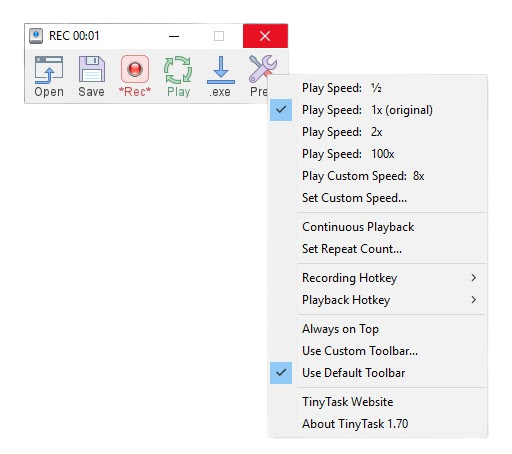
A built-in speed slider lets you play macros faster or slower than the original recording speed. Crank it up for batch operations where delays do not matter, or slow it down when the target application needs time to load between steps.
Compile to EXE
Turn any recorded macro into a standalone Windows executable. The compiled .exe runs the macro without requiring TinyTask to be installed on the target machine. Great for distributing automated routines to teammates who just need to double-click a file.
Portable – Only 36 KB
TinyTask is a single-file portable application. No installer, no dependencies, no .NET runtime, no registry changes. Drop the 36 KB EXE onto a USB stick, cloud drive, or desktop and it runs immediately. It does not write anything to your system outside its own process memory, so removing it is as simple as deleting the file. This makes TinyTask one of the smallest Windows utilities ever distributed.
Keyboard Shortcuts
All core functions have global hotkeys: Ctrl+Shift+Alt+R to record, Ctrl+Shift+Alt+P to play. These work even when TinyTask is minimized or behind other windows, so you can start and stop recordings without switching focus.
Multi-Language Support
TinyTask correctly records keystrokes in any keyboard layout or language active on your system. Whether you type in English, Spanish, Japanese, or Arabic, the captured input replays accurately through the Windows input system.
Always on Top Mode
Pin the TinyTask toolbar above all other windows so it stays accessible while you work in a different application. This is especially useful during recording sessions where you need the stop button visible at all times.
Minimal Resource Usage
Written in pure C with no runtime dependencies, TinyTask typically uses less than 1 MB of RAM and virtually zero CPU when idle. Even during active recording or playback, the footprint stays under 2 MB. It will not slow down older hardware or compete with resource-hungry applications.
Download TinyTask
Grab the official build directly from Vista Software – two formats, both free
TinyTask 1.77 for Windows
Portable freeware — no installation required
Verify Your Download
If you want to confirm you’ve got the unmodified Vista Software build, hash the file you downloaded and compare against the values below.
SHA-256 (TinyTask 1.77 EXE): 75e06ac5b7c1adb01ab994633466685e3dcef31d635eba1734fe16c7893ffe12
SHA-256 (TinyTask 1.77 ZIP): 6d5df8577a842c79dd4d4cb9b90cb11f5395d7a666d067ac835ffa244e253ac1
File size (EXE): 36,352 bytes (~36 KB)
File size (ZIP): 20,992 bytes (~21 KB compressed)
Last verified by Vista Software: April 28, 2026
On Windows, run certutil -hashfile tinytask-1-77.exe SHA256 in PowerShell or Command Prompt; the output should match the EXE hash above. The same EXE hash has been on independent antivirus record at lo4d.com since November 6, 2019, with 0 detections across 30 engines.
Tiny Clicker New
The latest improved version of TinyTask — faster, lighter, and built for modern Windows
TinyTask Chrome Extension
Record and replay browser macros directly in Chrome — no download needed
TinyTask desktop is Windows-only. Use the Chrome extension for cross-platform browser automation.
Getting Started with TinyTask
From first download to your first automated workflow in under five minutes
Downloading TinyTask
Head over to our download section and grab TinyTask 1.77 directly. You will find two options: a standalone EXE file and a ZIP archive. Both contain the exact same 36 KB program. The EXE option is the most popular because you can run it immediately after downloading – no extraction step required.
If your browser or antivirus flags the download, that is a false positive triggered by the small file size and the fact that TinyTask hooks into mouse and keyboard input (which is exactly how it records macros). We will address how to handle that in the next step.
The ZIP format is handy when you want to store TinyTask inside a folder with its .rec macro files, or if your workplace blocks direct EXE downloads. Simply extract the archive to any folder and you are ready to go. At 36 KB, the download completes almost instantly on any connection.
Tip: Save TinyTask.exe somewhere easy to reach – your Desktop or a dedicated “Tools” folder. Because it is portable, you can move it later without breaking anything.
Launching TinyTask for the First Time
Double-click the TinyTask.exe file. There is no installer – the toolbar window appears within a fraction of a second. On Windows 10 and Windows 11, you may see a Windows SmartScreen warning that says “Windows protected your PC.” This happens because TinyTask is not digitally signed with a paid code-signing certificate.
To get past SmartScreen:
- Click “More info” in the SmartScreen dialog (the text is small and easy to miss)
- Click “Run anyway” to launch the program
- Windows will remember your choice, so this prompt only appears once
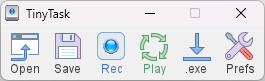
When TinyTask opens, you will see a compact horizontal toolbar with about 10 small buttons. From left to right, the buttons are: Open, Save, Record (red circle), Play (green triangle), Stop, Compile to EXE, Loop Count spinner, Speed slider, Minimize, and Always on Top pin. That toolbar is the entire application. There are no hidden menus, no settings screen, and no splash window.
Warning: If TinyTask fails to launch at all, right-click the EXE and choose “Run as administrator.” Some locked-down work environments require elevated privileges for programs that hook into keyboard and mouse input.
Recording Your First Macro
Here is a concrete example. Suppose you need to open Notepad, type a line of text, and save the file – and you want to automate it so a coworker can run the same sequence later.
- Click the red Record button on the TinyTask toolbar (or press Ctrl+Shift+Alt+R). The button will stay pressed to show that recording is active.
- Open the Start Menu, type “Notepad”, and press Enter to launch it.
- Type your text – for example, “Monthly report – March 2026”.
- Press Ctrl+S, choose a save location, type the filename, and click Save.
- Click the Stop button on TinyTask (or press Ctrl+Shift+Alt+R again to toggle recording off).
Your macro is now stored in memory. To play it back, click the green Play button or press Ctrl+Shift+Alt+P. TinyTask will repeat every mouse movement and keystroke you recorded, in the same order, at the same pace. Keep your hands off the mouse and keyboard during playback – any input from you will interfere with the replay.
To save the macro to a file, click the Save button (floppy disk icon). TinyTask saves recordings in its .rec format. You can share this file with anyone who has TinyTask, or you can compile it into a standalone EXE using the Compile button.
Playback, Loops, and Speed
Once you have a macro recorded or loaded from a .rec file, TinyTask gives you three controls that change how it plays back:
Loop Count: The number spinner next to the playback controls sets how many times the macro runs. Set it to 1 for a single run, 50 for fifty repetitions, or 0 (zero) for an infinite loop that runs until you click Stop. For data-entry work where you need to fill 200 rows, set the count to 200 and walk away.
Speed Slider: Drag the speed slider left to slow down playback or right to speed it up. The default position replays at 1x speed (the exact timing you recorded). For operations where the target app responds instantly, cranking the speed to maximum can finish a 5-minute macro in under 30 seconds. If an application is slow to respond between steps, slow the slider down so TinyTask does not click before the next screen loads.
Stopping Playback: Press Ctrl+Shift+Alt+P at any time to stop playback mid-sequence. You can also click the Stop button on the toolbar, but the hotkey is faster since TinyTask may be clicking elsewhere on screen during replay.
Tip: Before running a macro at high speed on 200 loops, do a single test run at normal speed first. This lets you catch any timing issues before the program fires off hundreds of rapid-fire actions.
Compiling and Sharing Macros
One of TinyTask’s most useful features is the ability to compile a recording into a self-contained .exe file. After recording or loading a macro, click the Compile button (the icon that looks like a small package or export arrow). TinyTask will ask you where to save the EXE. Name it something descriptive like “Fill_Report_Template.exe” and click Save.
The generated EXE is typically around 50-70 KB (the original 36 KB runtime plus your recorded macro data). Anyone with a Windows PC can double-click this file to run the macro without having TinyTask installed. This is perfect for creating one-click automation files for colleagues who are not comfortable working with macro software directly.
Keep in mind that compiled macros replay at fixed coordinates. If your coworker uses a different screen resolution or has the target application positioned in a different spot, the clicks may land in the wrong place. To avoid this, record your macros with the target application maximized – that way the UI elements sit in consistent positions regardless of screen size.
Tips, Tricks, and Best Practices
After using TinyTask for a while, you will pick up habits that make your macros more reliable:
- Always maximize windows before recording. Maximized apps have consistent button positions across different monitors. A macro recorded on a 1080p screen will fail on a 4K display if the window was floating at a specific size.
- Add brief pauses. If you need a delay during recording (for example, waiting for a web page to load), just sit still for a couple of seconds. TinyTask records the idle time along with the actions.
- Use keyboard shortcuts instead of clicking menus. Press Ctrl+S instead of clicking File > Save. Keyboard shortcuts work regardless of where the toolbar is positioned, making macros more resilient.
- Keep macros short and focused. Rather than one 10-minute macro that does everything, record three smaller macros for three distinct tasks. Shorter macros are easier to debug and reuse.
- Back up your .rec files. If you rely on a macro daily, save the .rec file to a cloud folder or USB drive. The files are tiny and easy to back up.
Keyboard Shortcuts Reference:
| Action | Shortcut |
|---|---|
| Start / Stop Recording | Ctrl+Shift+Alt+R |
| Start / Stop Playback | Ctrl+Shift+Alt+P |
For further help, jump to our FAQ section below, every question we’ve heard from TinyTask users in the last 18 months is answered there. Community discussions on Reddit (r/TinyTask and r/AutoHotkey threads) are also worth browsing if you run into a weird edge case the FAQ doesn’t cover.
How to Download TinyTask for PC
- Click the Download button at the top of this page — the file is
tinytask-1-77.exe(36 KB). - Save it anywhere — TinyTask doesn’t require installation; it runs directly from the .exe.
- First-run SmartScreen warning: click “More info” then “Run anyway.” TinyTask is unsigned but Vista Software-distributed and verified safe (see Is TinyTask Safe? for full scan details).
- Default hotkeys: Ctrl+Shift+Alt+R to record, Ctrl+Shift+Alt+P to play.
- Save your macro as a .rec file from File → Save.
- Replay or compile — File → Save As .exe creates a standalone macro binary (50 to 70 KB).
What Is tinytask.exe?
tinytask.exe is the single-file executable for TinyTask, distributed by Vista Software. The current version (1.77) is exactly 36,352 bytes, which works out to roughly 36 KB. There’s no installer because there’s nothing to install. You run the .exe directly, and when you close the window, nothing’s left running in the background.
The file doesn’t modify the registry, doesn’t write outside its own directory, and doesn’t make network connections. That’s been verified by Joe Sandbox and Hybrid Analysis runs against the exact SHA-256 we publish on this page. The hash is unchanged from the November 2019 release that lo4d.com first catalogued, so any TinyTask 1.77 binary that doesn’t match this hash has been modified by someone other than Vista Software.
Is TinyTask the Same as a “Tiny Clicker”?
“Tiny clicker” is a colloquial misspelling that usually refers to TinyTask, the free Windows macro recorder by Vista Software. TinyTask records and replays mouse clicks (so it works as an auto-clicker), plus keyboard input and mouse movement, which makes it functionally a tiny clicker plus a full macro recorder. The official build, available on this page, is 36 KB and runs without installation on Windows 10 and 11.
If you only need pure click-spam at a fixed interval and don’t care about recording sequences, a dedicated auto-clicker can be a better fit. TinyTask doesn’t support conditional logic or branching, so if your task needs “click here only if the screen shows X”, you’ll want AutoHotkey instead. For straight record-and-replay click loops though, TinyTask is hard to beat at 36 KB.
Is There a TinyTask Android App?
No. There’s no official TinyTask app for Android, iPhone, or any mobile OS. Vista Software hasn’t released a mobile version, so any APK or app advertising itself as “TinyTask” on the Play Store, third-party APK sites, or anywhere else isn’t from Vista Software. TinyTask is a Windows-only utility.
For mobile macro automation, see our TinyTask for Mobile guide, which covers verified alternatives for Android (MacroDroid, Auto Clicker – Automatic Tap) and iOS (Apple Shortcuts). The mobile space has its own ecosystem of legitimate macro tools, but none of them are TinyTask under another name.
Popular Guides & Resources
Everything you need to master TinyTask and automation tools for Windows, Mac, and more.
How to Use TinyTask
Complete beginner tutorial covering recording, playback, loops, and compiling macros to EXE.
Read guide → GuideIs TinyTask Safe?
Virus scan results, security analysis, and what 60+ antivirus engines say about TinyTask.
Read guide → ToolsBest Auto Clicker for Windows
10 free auto clickers tested and compared for gaming, work, and accessibility.
View picks → ToolsBest Free Macro Recorders
Top macro recording software for Windows. Record mouse clicks and automate any task.
View picks → FixTinyTask Not Working?
15 proven fixes for common problems including playback issues, admin errors, and Windows 11.
Get help → PlatformTinyTask for Mac
TinyTask is Windows-only. Here are the best Mac alternatives for macro recording.
See options → CompareTinyTask Alternatives
12 macro tools for every platform, from lightweight clickers to full automation suites.
Compare tools → PlatformTinyTask for Chromebook
3 best alternatives for Chrome OS. Native auto-clicker and browser extensions that work.
See options →Frequently Asked Questions
Real answers to the questions people actually ask about TinyTask
Is TinyTask free to download?
Yes, TinyTask is 100% free to download and use. It is classified as freeware by its developer, Vista Software, which means there is no trial period, no paid upgrade tier, and no feature gating. The full application ships as a single 36 KB executable file with every feature unlocked from the start.
Unlike many free tools that bundle adware or toolbars into their installer, TinyTask has no installer at all. You download the standalone EXE file, and that is the complete program. There are no hidden costs, no in-app purchases, and no subscription fees. The freeware license covers both personal and commercial use, so you can use it at work without needing a site license or company approval.
Vista Software publishes TinyTask through this site, thetinytask.com, which is the official source. Both the EXE and ZIP formats are available at no charge in our download section above. Both files are hosted directly on this site. No third-party redirect, no mirror, no wrapper installer. The byte you click on is the byte you download.
Pro tip: Bookmark TinyTask.exe on a USB drive so you always have it ready on any Windows machine you encounter, even ones without internet access. It is so small it fits alongside thousands of other files.
Is TinyTask safe for Windows 11?
Yes, TinyTask is safe to use on Windows 11 and has been tested across all recent Windows releases. The program is written in pure C with no external dependencies, meaning it does not rely on third-party libraries that might introduce vulnerabilities. At 36 KB, there is physically not enough code to hide malware – the entire binary is smaller than most image files.
Windows SmartScreen may flag TinyTask the first time you run it because the executable lacks a paid code-signing certificate. This is a common false positive for small freeware utilities and does not indicate any safety issue. To proceed, click “More info” in the SmartScreen dialog, then click “Run anyway.”
TinyTask hooks into keyboard and mouse input at the system level (that is how it records macros), which can trigger heuristic alerts in some antivirus scanners. These are behavioral false positives. If your antivirus quarantines the file, add an exception for TinyTask.exe in your security software’s settings. Programs like VirusTotal consistently show TinyTask as clean when scanned against 60+ antivirus engines.
Pro tip: If you want extra peace of mind, grab the ZIP version and verify the SHA-256 hash against the value we publish in the download section on this page. The current TinyTask 1.77 EXE SHA-256 is 75e06ac5b7c1adb01ab994633466685e3dcef31d635eba1734fe16c7893ffe12, and the ZIP is 6d5df8577a842c79dd4d4cb9b90cb11f5395d7a666d067ac835ffa244e253ac1. The same EXE hash has been on independent record at lo4d.com since November 2019, with zero detections across 30 antivirus engines.
For the official download, see the download section on this page. The file is served directly from this site, which is Vista Software’s distribution endpoint for TinyTask, no external redirect.
What are the system requirements for TinyTask?
TinyTask has the lowest system requirements of any macro recorder available. It needs Windows XP or later (including Vista, 7, 8, 8.1, 10, and 11), roughly 1 MB of free RAM during operation, and 36 KB of free disk space. That is it. There is no minimum CPU requirement, no GPU requirement, and no need for .NET Framework, Java, or any other runtime.
Because TinyTask is compiled as native x86 code, it runs on both 32-bit and 64-bit versions of Windows through the WoW64 compatibility layer. You do not need to choose a 32-bit or 64-bit version – the same single EXE works everywhere. It also runs on ARM-based Windows devices through x86 emulation, though ARM performance is identical to x86 at this tiny scale.
TinyTask does not require an internet connection for any of its functions. Recording, playback, file saving, and EXE compilation all happen locally. You can use it on an air-gapped machine with no network access whatsoever.
Pro tip: TinyTask works perfectly on virtual machines and Remote Desktop sessions. Just make sure the TinyTask window is active within the session, not on the host machine, since it records at the screen coordinate level.
Check our features section for a detailed look at what you get inside those 36 kilobytes.
Does TinyTask work on Mac or Linux?
No, TinyTask is a Windows-only application. It is built using native Win32 API calls for mouse and keyboard hooking, which means it cannot run natively on macOS or Linux. Vista Software does not offer Mac or Linux versions, and there is no official plan to port the software to other platforms.
If you need TinyTask specifically on a non-Windows system, your best option is running it inside a Windows virtual machine. VirtualBox (free) or Parallels (macOS) can host a lightweight Windows installation, and TinyTask runs perfectly inside those environments. Wine on Linux may also work for basic recording and playback, though results vary depending on your Wine version and configuration.
For native Mac alternatives, consider Automator (built into macOS for free) or Keyboard Maestro ($36, paid). On Linux, xdotool combined with shell scripting provides similar mouse/keyboard automation capabilities. AutoKey is another free Linux option with a graphical interface.
Pro tip: If you only need TinyTask occasionally on a Mac, a free Windows VM through VirtualBox with a Windows evaluation ISO from Microsoft gives you a 90-day window to use TinyTask at no cost.
For the Windows download, head to our download section.
How do I update TinyTask to the latest version?
TinyTask does not have a built-in auto-update feature. To update to the latest version, download the newest TinyTask.exe from the official source and replace the old file. The current version is 1.77. Since TinyTask is a portable single-file program, updating is as simple as deleting or overwriting the old EXE with the new one.
Your existing .rec macro files will continue to work with new versions. The .rec file format has remained stable across TinyTask releases, so macros recorded in older versions play back correctly in version 1.77. You do not need to re-record your macros after updating.
- Visit our download section and download the latest TinyTask EXE
- Close TinyTask if it is currently running
- Replace the old TinyTask.exe with the newly downloaded file
- Launch the new version – your .rec files will load normally
TinyTask does not store settings in the Windows registry or in config files, so there is nothing to migrate. All preferences reset to defaults each time you launch the program, and the defaults are the same across versions.
Pro tip: TinyTask updates are infrequent because the program is genuinely stable. Check this page once every few months instead of any third-party mirror. When Vista Software releases a new build, the download section here gets updated the same day. The release before 1.77 was 1.74, and 1.77 has been the current version since 2018, so don’t be alarmed if the version number looks unchanged across visits, that’s the point of a stable utility. Version 1.77 has been the current release for an extended period.
How do I record a macro in TinyTask?
Recording a macro in TinyTask takes three clicks. Open TinyTask.exe (the toolbar appears instantly), click the red Record button or press Ctrl+Shift+Alt+R, perform the actions you want to automate, and then click Stop or press the same hotkey to end the recording.
Here is the step-by-step process:
- Launch TinyTask.exe. The small toolbar appears in the upper-left area of your screen.
- Arrange your target application exactly how you want it. Maximize windows if possible for consistency.
- Click the red circle button (Record) on the toolbar. It will stay pressed to indicate recording is active.
- Perform your mouse clicks, movements, and keyboard typing at a normal pace. TinyTask captures everything including idle pauses.
- When finished, click the Stop button (square icon) or press Ctrl+Shift+Alt+R again.
- Click the Save button (floppy disk icon) to store your recording as a .rec file.
TinyTask records absolute screen coordinates, meaning mouse clicks are tied to specific pixel positions. If you resize or move the target application after recording, the clicks will land in the wrong spots. Always position your windows before you start recording.
Pro tip: Use keyboard shortcuts (like Ctrl+C, Ctrl+V, Tab) instead of mouse clicks wherever possible. Keyboard actions are immune to window-position issues and make macros much more reliable.
See our Getting Started guide for a full walkthrough with a real-world example.
Can TinyTask run macros in a loop?
Yes, TinyTask has a built-in loop counter on the toolbar. You can set a specific number of repetitions or run the macro indefinitely until you manually stop it.
The loop count spinner is located on the right side of the toolbar, next to the speed slider. Set it to any number to repeat the macro that many times. Common setups include:
- 1 – Single run (default). Plays the macro once and stops.
- 10-500 – Fixed repetitions. Useful for data entry where you know exactly how many rows or forms to fill.
- 0 – Infinite loop. The macro repeats forever until you press Ctrl+Shift+Alt+P or click Stop.
When running loops, the speed slider becomes especially important. If the target application needs time between actions (like a web page loading between form submissions), keep the speed at 1x or slower. For local applications that respond instantly, you can safely increase the speed to reduce total execution time.
Pro tip: For infinite loops, always keep one hand near the keyboard so you can press Ctrl+Shift+Alt+P to stop playback quickly. Without this, TinyTask will keep clicking and typing until you manage to stop it.
Learn more about loop configuration in our Getting Started section.
How to fix TinyTask not working or crashing?
TinyTask rarely crashes because of its minimal codebase, but playback issues are common and usually caused by one of a few predictable problems. Here are the most frequent issues and their fixes:
Macro clicks in the wrong place: This happens when the target application is in a different position or size than when you recorded. Fix: maximize the target window before recording, and maximize it again before playback. Record new macros at your primary screen resolution.
TinyTask does not launch: Windows SmartScreen may silently block the program. Right-click TinyTask.exe, select Properties, and check “Unblock” at the bottom of the General tab. Click Apply. Alternatively, right-click the EXE and choose “Run as administrator.”
Recording does not capture anything: Some applications run with elevated privileges (as administrator). If TinyTask runs as a standard user, it cannot hook into admin-level applications. Launch TinyTask as administrator to fix this.
Playback is too fast or too slow: Adjust the speed slider on the toolbar. If you recorded with long pauses and the macro takes forever, speed it up. If the target app cannot keep up, slow it down.
- Try running TinyTask as administrator (right-click > Run as administrator)
- Check if your antivirus is blocking TinyTask – add an exception if needed
- Re-download the EXE from our download section in case the file was corrupted
- Make sure no other macro software is running simultaneously – hotkey conflicts can prevent recording
Pro tip: If TinyTask’s global hotkeys conflict with another program (some GPU control panels use Ctrl+Shift+Alt combinations), close the conflicting software before recording.
Can I compile TinyTask macros into EXE files?
Yes, TinyTask can compile any recorded macro into a standalone Windows executable. This is one of its most distinctive features – the compiled EXE contains both the TinyTask runtime and your macro data, so the recipient does not need TinyTask installed to run it.
To compile a macro to EXE:
- Record your macro or load an existing .rec file
- Click the Compile button on the toolbar (the icon that looks like a package/export)
- Choose a save location and filename for the new EXE
- TinyTask creates the executable file immediately
The resulting EXE is typically 50-70 KB depending on the length of your macro recording. It behaves exactly like clicking Play in TinyTask – the macro runs once and the program exits. Compiled EXEs do not support loop counts or speed adjustments; they run at the speed the macro was recorded.
This feature is particularly useful in corporate environments where you can distribute a single EXE to team members who need to run a specific automated task but should not need to learn macro software. They just double-click the file and the task runs.
Pro tip: Give your compiled EXEs descriptive names like “Fill_Timesheet_Template.exe” or “Rename_Photo_Batch.exe” so recipients understand what the macro does at a glance.
See our features section for more details on TinyTask’s compile functionality.
TinyTask vs AutoHotkey – which is better?
TinyTask and AutoHotkey serve different audiences and solve different problems. TinyTask is a visual point-and-click macro recorder for people who want to automate simple, repetitive tasks without writing any code. AutoHotkey is a full scripting language for Windows automation that can handle complex logic, conditional statements, and custom GUI applications.
Choose TinyTask when you need to:
- Record and replay a simple mouse-and-keyboard sequence in under a minute
- Share a macro as a standalone EXE with non-technical users
- Automate tasks on a machine where you cannot install software (TinyTask is portable)
- Avoid any learning curve – TinyTask has zero configuration
Choose AutoHotkey when you need to:
- Add conditional logic (if/else), variables, or loops with changing data
- Read from files, parse text, or interact with APIs
- Create custom keyboard shortcuts or remap keys system-wide
- Build GUI dialogs or interactive automation tools
TinyTask’s advantage is simplicity: 36 KB, no install, no learning curve. AutoHotkey’s advantage is power: it can do virtually anything on Windows but requires learning its scripting syntax. Many users actually keep both tools around – TinyTask for quick one-off recordings, and AutoHotkey for anything that needs logic.
Pro tip: If you find yourself wanting “record, but skip step 3 if condition X is true,” that is where TinyTask hits its ceiling and AutoHotkey picks up.
Where is the official download for TinyTask?
The official download for TinyTask is on this page (thetinytask.com), maintained by Vista Software. Both the direct EXE file and a ZIP archive are available in our download section above. The file is served from this site. There’s no redirect to a third-party domain, no GitHub release on an anonymous personal account, and no installer wrapper. Other sites advertising “official TinyTask downloads” (including tinytask.net, tinytask.app, and tinytaski.com) aren’t affiliated with Vista Software. The simplest way to know you’ve got the real build: the EXE is exactly 36,352 bytes (about 36 KB). Anything significantly larger has been repackaged.
Be cautious about downloading TinyTask from third-party domains. The official 36 KB binary is published only on this site. Mirrors that wrap the executable inside an installer to add toolbars, browser extensions, or “PC optimizers” are common in this category. Quick rule of thumb: if the file you downloaded is more than 36 KB, it isn’t the original Vista Software build, it’s been repackaged. The official TinyTask executable is exactly 36 KB. If the download is significantly larger, it is likely a modified version.
Quick verification checklist after downloading:
- File size should be approximately 36 KB (36,864 bytes or close to it)
- File name should be TinyTask.exe
- There should be no installer – the EXE runs directly
- The program should show a compact toolbar with no splash screen or registration prompt
Pro tip: If your workplace firewall blocks downloads from this site, save the ZIP version onto a USB drive from an unrestricted machine and verify the 36 KB file size before running it. Don’t download TinyTask from third-party “mirrors”, there’s no Vista Software-authorized mirror, and the binary is only published here. You can also bring TinyTask in on a USB drive from a non-restricted network.
How to uninstall TinyTask completely?
Since TinyTask is a portable application with no installer, uninstalling it means deleting the TinyTask.exe file. That is the entire uninstall process. There are no registry entries to remove, no AppData folders to clean up, no services to stop, and no Start Menu shortcuts to delete.
Complete removal steps:
- Close TinyTask if it is currently running (right-click the toolbar and close, or use Task Manager)
- Navigate to the folder where TinyTask.exe is stored
- Delete TinyTask.exe
- Optionally, delete any .rec macro files you no longer need from the same folder
- Empty the Recycle Bin if you want the file permanently gone
TinyTask does not write to HKEY_LOCAL_MACHINE or HKEY_CURRENT_USER in the Windows registry. It does not create folders in %AppData%, %LocalAppData%, or %ProgramData%. It does not register as a Windows service or create scheduled tasks. The program lives and dies entirely within its own EXE file.
If you compiled any macros to standalone EXEs, those files also need to be deleted separately since they are independent executables that do not reference TinyTask.exe at all.
Pro tip: Before deleting TinyTask, save any important .rec files to a backup location in case you want to use them again later.
Does TinyTask work offline?
Yes, TinyTask works 100% offline. The program never contacts any server, does not check for updates over the internet, does not send telemetry or usage data, and does not require activation or license verification. Once you have the 36 KB EXE file on your machine, you can disconnect from the internet entirely and every feature continues to work without restriction.
All operations – recording macros, playing them back, adjusting speed and loops, saving .rec files, and compiling to EXE – happen locally on your machine using only CPU and RAM. There is no cloud component, no account system, and no online dependency of any kind.
This makes TinyTask ideal for air-gapped environments (military, medical, or financial systems with no internet access), field laptops, and situations where you need automation on a machine that has restricted or no network connectivity. Just copy the 36 KB file to the machine via USB drive and you are fully operational.
Pro tip: Carry TinyTask on the same USB drive as your .rec macro files for a fully portable, offline automation toolkit that works on any Windows PC from XP onwards.
Download TinyTask once from our download section and it works forever without any internet connection.
Can I use TinyTask for gaming?
TinyTask can automate basic, repetitive actions in games, but it has significant limitations compared to dedicated game macro tools. It records and replays mouse clicks and keyboard presses at fixed screen coordinates, which works for games with static UI elements – think clicking the same buttons in a browser-based game, auto-fishing in an idle game, or repeating a crafting sequence in an RPG where the inventory window stays in a fixed position.
Where TinyTask falls short for gaming:
- No pixel detection: TinyTask cannot check what is on screen before clicking. It blindly replays coordinates regardless of game state.
- Coordinate-dependent: If the game window moves, resizes, or if a UI element shifts position, the macro breaks.
- No conditional logic: You cannot create “if health is low, use potion” type macros. Every playback is identical.
- Anti-cheat detection: Games with anti-cheat software (like EasyAntiCheat, BattlEye, or Vanguard) may detect TinyTask’s keyboard and mouse hooks and flag or ban your account.
For simple clicker games, browser games, and single-player titles without anti-cheat, TinyTask works fine. For competitive multiplayer games, using any automation tool risks a ban and is generally against the game’s terms of service.
Pro tip: If you use TinyTask for gaming, always run the game in windowed mode at a fixed resolution so the UI positions stay consistent. Fullscreen mode can change coordinate mapping unpredictably.
Does TinyTask support scheduling or timed execution?
TinyTask does not have built-in task scheduling. It cannot start a macro automatically at a specific time, date, or interval on its own. However, you can combine TinyTask with Windows Task Scheduler to achieve timed execution without any additional software.
Here is how to schedule a TinyTask macro:
- Record your macro and compile it to a standalone EXE using TinyTask’s compile feature
- Open Windows Task Scheduler (search for “Task Scheduler” in the Start Menu)
- Click “Create Basic Task” and give it a descriptive name
- Set your trigger: daily, weekly, at logon, or at a specific time
- For the action, choose “Start a program” and browse to your compiled macro EXE
- Click Finish to create the scheduled task
The compiled EXE will launch at the scheduled time, run the macro once, and exit. Keep in mind that the screen needs to be unlocked and the target application needs to be open and positioned correctly for the macro to work. Task Scheduler will launch the EXE even if the screen is locked, but since TinyTask relies on screen coordinates, the macro will fail if no desktop is visible.
Pro tip: If you need the macro to run unattended (like overnight), configure your Windows power settings to prevent sleep and disable the lock screen. You can also chain a “launch the target app” script before the macro EXE in Task Scheduler.
See our Getting Started guide for instructions on compiling macros to EXE.
Is TinyTask open source?
No, TinyTask is not open source. It is distributed as freeware by Vista Software, meaning you can use it for free without restrictions, but the source code is not publicly available. You cannot view, modify, or redistribute the source code.
The freeware license allows unlimited personal and commercial use at no cost. You can distribute the unmodified TinyTask.exe file freely (for example, sharing it with coworkers or including it in a tools folder), but you cannot decompile, reverse-engineer, or create derivative works based on the binary.
If you specifically need an open-source macro recorder, here are alternatives:
- AutoHotkey – Open source (GPLv2), scripting-based, extremely powerful but requires learning the AHK language
- Macro Recorder (by JitBit) – Has an open-source community edition with basic recording capabilities
- xdotool – Open source command-line tool for Linux (not Windows)
Many users prefer TinyTask over open-source alternatives specifically because of its simplicity. Open-source macro tools tend to be more complex since they cater to developers who want customization, while TinyTask targets users who just want to click Record and Play.
Pro tip: If transparency about what the program does is your main concern, TinyTask’s 36 KB size is itself a form of assurance. There is not enough room in the binary for anything beyond the core recording and playback functionality.
Is tinytask.net the official TinyTask site?
No. thetinytask.com is the official TinyTask download site, run by Vista Software. tinytask.net is an unrelated third-party domain whose ownership and trust posture are uncertain. Its current download button redirects to a third-party GitHub account (Berniece-wq) rather than hosting the binary itself, and independent security scanners including GridinSoft have flagged the domain.
For the verified, Vista Software-distributed TinyTask 1.77 binary, download from this page. The published SHA-256 of our EXE matches the canonical 2019 release on independent antivirus record (0/30 detections at lo4d.com), which is how you confirm the build is unmodified.